
Table of Contents
- Understand the Burbank Real Estate Market Before You Bid
- Get Pre-Approved and Prove Your Buying Power
- Real Estate Escalation Clause Examples and How to Use Them
- How to Write a Winning Offer Letter for a House
- Waiving Home Inspection Contingencies in California: Risk vs. Reward
- Structure Your Offer to Win Without Overpaying
- Common Mistakes That Cost You Bidding Wars in Burbank
- Conclusion
Last Updated: August 9, 2026
Understand the Burbank Real Estate Market Before You Bid
Burbank’s real estate market moves fast. Properties in desirable neighborhoods like Burbank Rancho often receive multiple offers within days of listing. Successful buyers in competitive situations aren’t bidding blindly, they understand what’s driving prices in their specific neighborhood.
Start by researching recent comparable sales in your target area from the last 60-90 days with similar square footage, lot size, and condition. Pay attention to the list-to-sale price ratio. If homes consistently sell above asking, you’re in a seller’s market where escalation clauses and contingency removal become critical. If homes sell near or below asking, you have more flexibility.
Next, identify what makes your specific Burbank neighborhood desirable right now: proximity to studios, school district reputation, or walkability to local restaurants. Understanding seller motivation helps you craft an offer that resonates emotionally. Finally, track days-on-market for comparable properties. Fast sales (under 14 days) signal strong demand and competitive bidding. Slower sales (30+ days) give you negotiating room.
Get Pre-Approved and Prove Your Buying Power
Pre-approval is your entry ticket in a hot market. Get pre-approved by a mortgage lender at least two weeks before making offers. A strong pre-approval letter specifies your maximum loan amount, down payment capacity, and any conditions. Traditional banks or mortgage brokers carry more weight with sellers than online lenders.
Pre-approval and proof of funds are different. Pre-approval shows you can borrow money. Proof of funds shows you have cash available now. If you’re putting down 20% or more, or making a cash offer, you need bank statements, investment account statements, or a gift letter dated within 30 days of your offer.
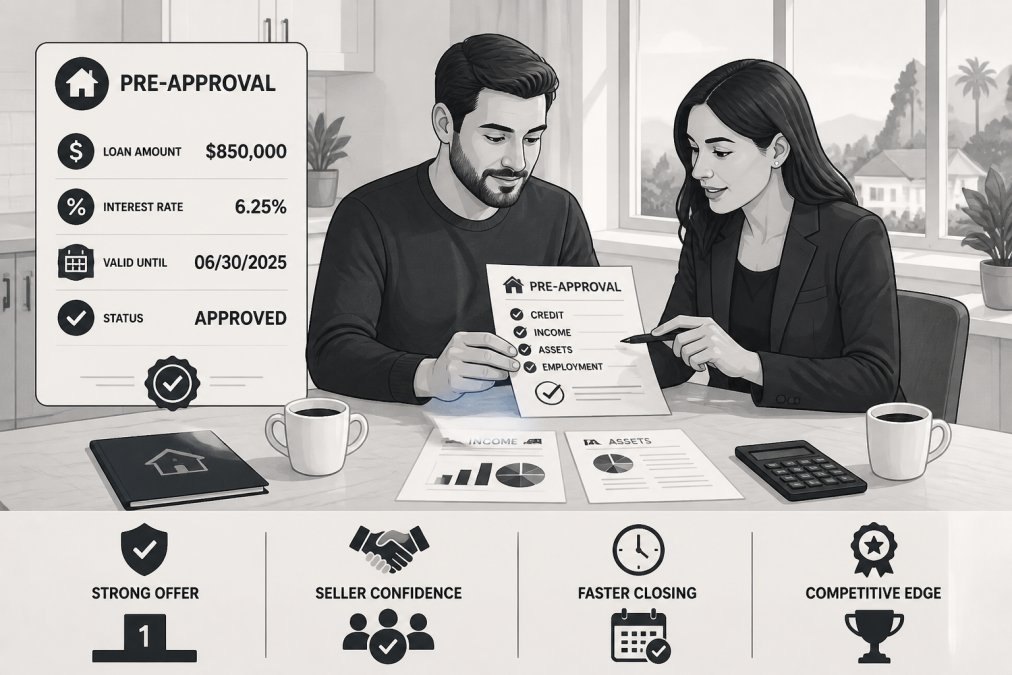
In Burbank’s competitive market, some sellers request proof of funds even with financed offers. Have your documentation ready before writing an offer. When your agent submits your pre-approval, proof of funds, and personal letter alongside your offer, this complete package signals you’re organized, serious, and ready to close.
Real Estate Escalation Clause Examples and How to Use Them
An escalation clause automatically increases your offer price if another buyer makes a higher offer, up to a maximum limit you set. They’re powerful tools in bidding wars but frequently misused.
Here’s how they work: You offer $850,000 with an escalation clause to $900,000. If the seller receives an offer for $870,000, your offer escalates to $875,000 (the competing offer plus your increment). Escalation clauses signal confidence and commitment, and sellers often respond positively.
However, escalation clauses carry real risks. First, the seller must provide proof of the competing offer for your clause to trigger. Some sellers refuse to disclose competing bids. Second, escalation clauses can backfire if you set your maximum too high, you might overpay for a property worth less.
The best escalation clauses include three conditions: (1) proof of a competing written offer, (2) a reasonable increment (not $1,000 jumps), and (3) a realistic maximum you’d actually be comfortable paying. Don’t use an escalation clause to avoid thinking about your real maximum price. Set it honestly, then stick to it.
How to Write a Winning Offer Letter for a House
The personal offer letter has become one of the most underrated tools in competitive real estate markets. A strong offer letter can tip the scales when two financial offers are nearly identical.
Sellers are humans, not algorithms. They want to know who’s buying their home and why they love it. Start with authenticity. Explain why you love the home and neighborhood specifically. If you’re relocating to Burbank for a job, say so. If you’re drawn to Burbank Rancho’s character, mention it. Be specific rather than clichéd.
Next, address seller concerns. If you’re a first-time buyer, emphasize your commitment. If you’re relocating from out of state, explain your timeline and familiarity with the area. If you have pets, describe them positively and assure the seller they’ll be well-cared for.

Keep the letter to one page, single-spaced. Include a professional photo of your family if you have one, this humanizes your offer. Avoid oversharing about financial struggles, job insecurity, or personal drama. Don’t promise renovations if the seller is emotionally attached to the home’s current state. Have your agent include the letter with your formal offer, pre-approval, and proof of funds.
Waiving Home Inspection Contingencies in California: Risk vs. Reward
Waiving home inspection contingencies is one of the highest-stakes decisions in a bidding war. It removes a major contingency protecting you, which is why sellers love seeing it.
A home inspection contingency gives you the right to hire a professional inspector to identify defects. If significant problems emerge, foundation issues, roof damage, electrical problems, you can renegotiate, request repairs, or walk away. Waiving this contingency means buying "as-is" without that safety net.
California law requires sellers to disclose known defects through a Transfer Disclosure Statement (TDS) and other documents. You’re not blind if you waive inspection; you still have the seller’s disclosures to review.
The strategic middle ground: Don’t waive the inspection contingency entirely. Instead, shorten the inspection period from 17 days to 7-10 days and make contingency removal conditional on what the inspection reveals. This signals seriousness while protecting you from catastrophic surprises.
If you do waive the inspection contingency, get a pre-inspection before making your offer. Pay for a professional home inspector to examine the property before submitting your bid. This costs $400-800 but is far cheaper than discovering major problems after waiving your contingency. California law also gives you a 3-day right to cancel after signing if you discover serious problems in the seller’s disclosures.
Structure Your Offer to Win Without Overpaying
The strongest offers in bidding wars aren’t always the highest ones. Structure matters as much as price.
A 20% down payment signals financial strength and reduces appraisal risk. If putting down less, compensate with strong proof of funds and a pre-approval letter. Some buyers offer to cover an appraisal gap, if the home appraises for less than your offer price, you’ll pay the difference in cash. This removes a major seller concern.
Consider your closing timeline. Most purchases close in 30-45 days. If you can close in 21-30 days, that’s attractive to sellers wanting to move quickly. Be realistic about what you can actually achieve.
Contingencies are your negotiating currency. Keep a financing contingency and appraisal contingency unless you’re willing to cover the gap. Consider shortening the inspection contingency rather than eliminating it entirely.
Offer a higher earnest money deposit. The standard is 2-3% of purchase price. Offering 4-5% signals serious intent and gives the seller confidence you won’t back out. Finally, include a kick-out clause allowing the seller to continue marketing for 48-72 hours after your offer. This protects the seller by letting them accept a higher offer if one comes in, making your offer less threatening.
Common Mistakes That Cost You Bidding Wars in Burbank
Going in without a clear maximum price. Before making any offer, define your absolute maximum price with your lender and agent. Write it down. When you’re in a bidding war, that number is your anchor.
Overestimating what the market will support. Get a comparative market analysis from an experienced agent. Understand what comparable homes actually sold for, not what they listed for.
Making an offer without contingency removal strategy. Decide in advance which contingencies you’re willing to remove and under what conditions. This removes emotion from the decision.
Neglecting the personal letter. A thoughtful, genuine letter can move a seller emotionally when financial offers are close.
Trusting inexperienced agents. Your agent’s negotiating skill directly affects your ability to win bidding wars. An experienced agent knows the local market, understands seller psychology, and structures offers strategically.
Ignoring the property’s actual condition. If you’re waiving inspection contingencies, you must understand what you’re buying. Get a pre-inspection and have your agent walk through critically.
Underestimating closing costs and reserves. Make sure your total financial picture is realistic, including closing costs, property taxes, insurance, and HOA fees.
Winning bidding wars in Burbank requires financial strength, strategic structure, and emotional intelligence. You need pre-approval and proof of funds to be taken seriously. You need an escalation clause and offer letter that signal genuine intent. You need to understand your market deeply enough to know what you’re competing against. And you need an experienced agent who understands Burbank’s unique dynamics.
Will Flannigan Real Estate brings nearly two decades of local market knowledge and a fiduciary approach that prioritizes your long-term interests. When you’re making one of the largest financial decisions of your life, that expertise matters. Contact Will Flannigan Real Estate today to discuss your buying strategy and get a personalized market analysis for your target neighborhood.
| Strategy | Best For | Timeline | Risk Level |
|---|---|---|---|
| Escalation clause | Competitive markets with multiple offers | Immediate decision | Low (if maximum set realistically) |
| Contingency removal | Sellers market with strong buyer demand | Before offer submission | Medium (depends on inspection timing) |
| Appraisal gap coverage | Waiving appraisal contingency | At time of offer | High (out-of-pocket cost) |
| Shortened inspection period | Balancing speed and due diligence | 7-10 days | Medium (faster decision, less inspection time) |
| Higher earnest money | Signaling serious intent | At offer submission | Low (refundable if contingencies met) |
Frequently Asked Questions
What are the most effective strategies to win a bidding war in Burbank?
To win bidding wars in Burbank, combine multiple strategies: get pre-approved to show serious intent, offer proof of funds, use an escalation clause to stay competitive without overcommitting, write a personal letter explaining why you love the home, offer flexible closing dates, and remove non-essential contingencies. The Burbank market values speed and certainty, sellers want buyers who can close quickly and won't back out. Local market knowledge also matters: understanding neighborhood values and recent sales helps you pitch a competitive yet realistic offer.
Should I waive contingencies to win a home bid in Burbank?
Waiving contingencies is risky and should only be done strategically. A home inspection contingency protects you from buying a property with hidden defects. In California, you can waive it, but only after a professional inspection confirms the property's condition. Waiving a financing contingency is riskier, it means you're committed even if your loan falls through. In Burbank's competitive market, waiving the appraisal gap (agreeing to pay above appraised value) is more common than waiving inspections. Always consult with a real estate attorney before waiving any contingency.
What is the role of an escalation clause in a competitive Burbank market?
An escalation clause automatically increases your offer if the seller receives higher bids, up to a maximum amount you set. For example, you might offer $800,000 with a clause that escalates $10,000 above any competing offer, up to $850,000. This shows the seller you're serious without committing to an inflated price upfront. In Burbank's sellers market, escalation clauses are effective because they give sellers confidence you'll match competition while protecting your own finances. Always include a proof-of-funds requirement in your escalation clause to prevent frivolous competing bids.
How can I make my offer stand out without overpaying in Burbank?
Focus on offer terms beyond price. Write a compelling personal letter explaining your connection to the home and neighborhood. Offer flexible closing dates or a longer escrow period if the seller needs time. Provide proof of funds and a strong pre-approval letter to eliminate financing concerns. Use an escalation clause instead of bidding blindly. Research the listing agent's priorities, some sellers care more about certainty of closing than absolute price. In Burbank, where many sellers are long-time residents, demonstrating respect for the home and neighborhood can outweigh a slightly higher offer from an impersonal investor.
This article was written using GrandRanker