
Table of Contents
- Step 1: Get Pre-Approved and Know Your Budget
- Step 2: How to Analyze Real Estate Comps and Market Value
- Step 3: Identify Warning Signs of Overpaying
- Step 4: What Is an Appraisal Gap and How to Mitigate It
- Step 5: Negotiating Home Price Tips and Leverage
- Step 6: Manage Emotional Buying and FOMO
- Step 7: Conduct Due Diligence Before Making an Offer
- Conclusion
Last Updated: August 16, 2026
Step 1: Get Pre-Approved and Know Your Budget
Before house hunting, get a mortgage pre-approval letter. This tells you the maximum a lender will finance based on your income, debt, and credit score. Your actual budget should be 20-30% below the pre-approval ceiling to protect yourself from overextending.
Calculate your debt-to-income ratio. Lenders typically want this below 43%, meaning your monthly debt payments shouldn’t exceed 43% of your gross monthly income. If you earn $6,000 per month, total debt payments shouldn’t exceed $2,580.
Will Flannigan Real Estate recommends working with a lender early, even before you’re serious about buying. A brief conversation clarifies what price range is realistic. Set a hard budget ceiling, write it down, and share it with your real estate agent. The emotional pressure of bidding wars will test your discipline, and having a clear number in advance makes it easier to walk away.
Step 2: How to Analyze Real Estate Comps and Market Value
Comparable sales, or "comps," are the foundation of realistic pricing. A comp is a recently sold property similar to the one you’re considering: same neighborhood, similar size, similar condition, sold within the last 90 days.
Pull comps yourself using public MLS data, Zillow, or Redfin. Look for at least 3-5 recent sales of comparable properties in the same neighborhood. Pay attention to days on market: homes that sold in 5 days versus 45 days tell different stories about market conditions.
Adjust for differences. If your target home has an updated kitchen and the comp doesn’t, add value. If your target home is on a busy street and the comp is on a quiet cul-de-sac, subtract value. Calculate the price per square foot for each comp and your target property. If comps average $350 per square foot and your target is priced at $400 per square foot, that’s a red flag.

Watch for market saturation. In a seller’s market with few homes for sale, comps may be outdated. In a buyer’s market with 6+ months of inventory, comps are more reliable. Will Flannigan Real Estate emphasizes that analyzing comps requires discipline. Force yourself to do the math before you tour the home, not after.
Step 3: Identify Warning Signs of Overpaying
The first warning sign is urgency. If an agent pressures you to make an offer quickly or a seller pushes for a fast close, slow down. Urgency is the enemy of rational decision-making.
A listing price significantly above recent comps is a red flag. If comparable homes sold for $550,000 and this one is listed at $625,000, the seller is testing the market. Homes listed for 60+ days that get delisted and relisted are using a tactic to reset the "days on market" clock, be skeptical.
Bidding wars create artificial urgency and inflate prices. If you find yourself in one, ask: would I still want this home at this price if there were no other offers? If the answer is no, step back.
Inspection reports revealing major issues, foundation problems, roof needing replacement, electrical issues, are warning signs the price should be lower. A $15,000 inspection can reveal $50,000 in hidden costs. If listing photos show a pristine kitchen but the inspection reveals outdated wiring, cosmetics are hiding problems.
Step 4: What Is an Appraisal Gap and How to Mitigate It
An appraisal gap occurs when you offer more for a home than it appraises for. You offer $500,000, the bank’s appraiser values it at $480,000, and you’re stuck. The lender won’t finance the full amount because the collateral isn’t worth what you’re paying.
Include an appraisal contingency in your offer. This allows you to walk away or renegotiate if the appraisal comes in low. Use comps strategically in your offer letter to give the appraiser context. Be prepared to cover a small gap with cash if necessary, but don’t commit to large gaps. If the appraisal gap is $30,000 or more, that signals you’ve overpaid.
Request a second appraisal if the first seems low. This costs $400-600 but may be worth investigating. However, second appraisals often confirm the first, so use this sparingly. Will Flannigan Real Estate advises that understanding appraisal gaps protects you from a common trap: winning a bidding war only to discover the home doesn’t appraise and you’re forced to cover the difference or lose your deposit.
Step 5: Negotiating Home Price Tips and Use
Negotiating home price tips begin with understanding your leverage. In a buyer’s market (more homes for sale than buyers), your leverage is high. Sellers are motivated, and you can negotiate harder on price, request repairs, and include contingencies. In a seller’s market, your leverage is low.
Make your first offer strong but not desperate. If the asking price is $500,000 and comps support $480,000, offer $475,000 and explain your reasoning with comp data. Use inspection findings as leverage. If the inspection reveals $20,000 in needed repairs, ask the seller to credit that amount or reduce the price.
Request a pre-inspection before making an offer if the seller allows it. You’ll know the home’s condition before committing and can factor repairs into your offer price from the start. Homes listed in winter often sit longer, giving you more negotiating power. Walk away from deals that don’t make financial sense, this is your ultimate leverage. Sellers sense desperation, and if you’re willing to lose a deal, you negotiate from strength.
Step 6: Manage Emotional Buying and FOMO
Fear of missing out (FOMO) is the primary driver of overpaying for homes. Scarcity, competition, and time pressure all activate FOMO. Agents know this and use it intentionally.
Separate the emotional experience from the financial decision. Tour homes with a checklist, not a heart. Does it meet your criteria? Is the price justified by comps? Can you afford it comfortably?
Set your budget and walkaway price before you start shopping. Write them down and share them with your real estate agent. When you’re in a bidding war, your emotions will pressure you to exceed these limits. Having a pre-committed number makes it easier to say no.
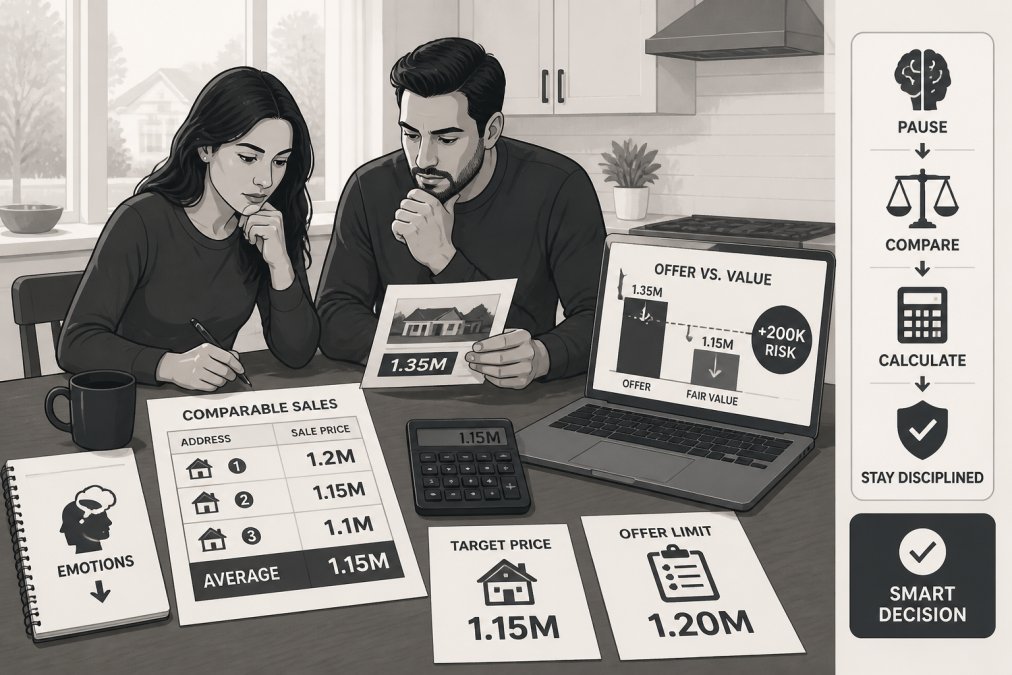
Talk to your partner or a trusted advisor before making an offer. A second opinion provides perspective. Remember that another home will come along. Overpaying for this home means less money for repairs, renovations, or future opportunities. Will Flannigan Real Estate has seen countless buyers regret overpaying due to emotional decisions. The regret compounds when the home needs repairs or when the market shifts.
Step 7: Conduct Due Diligence Before Making an Offer
Due diligence is thoroughly investigating a property before committing to it. Start with the property tax assessment. Look up the assessed value, tax rate, and projected annual property tax bill. Property taxes vary dramatically and can significantly impact your monthly housing costs.
Research HOA fees if applicable. HOA fees can range from $200 to $2,000+ per month. Request the HOA’s financial statements and reserve fund status. A poorly funded reserve can mean special assessments down the road.
Check the neighborhood’s future development plans. Is a highway, shopping center, or other project planned nearby? Local government websites have zoning and development information. Review the title report before closing, it reveals liens, easements, or ownership disputes. A clear title is essential.
Get a home inspection by a licensed inspector. This is non-negotiable. Budget $400-800 for a thorough inspection covering the roof, foundation, electrical systems, plumbing, HVAC, and structural integrity. Research the neighborhood’s property values over time. Are homes appreciating or depreciating? A neighborhood with declining values is a poor investment.
Will Flannigan Real Estate emphasizes that due diligence prevents overpaying for hidden problems. Thorough investigation protects your investment and your peace of mind.
Avoiding overpaying for a home requires discipline, data, and emotional control. Get pre-approved, analyze comps, identify red flags, understand appraisal gaps, negotiate strategically, manage FOMO, and conduct thorough due diligence. Each step protects you from a costly mistake.
Will Flannigan Real Estate brings nearly 20 years of living in the area and more than a decade of real estate experience and a fiduciary mindset to every transaction. Whether you’re buying your first home or navigating a complex purchase in a competitive market, having an experienced advisor who prioritizes your financial interests makes the difference. What’s My Home Worth? Start with a personalized consultation to understand your market position and make confident decisions.
Frequently Asked Questions
What role do comparable sales (comps) play in avoiding overpayment?
Comparable sales show what similar homes in your neighborhood sold for recently, giving you an objective baseline for fair market value. By analyzing comps, you can identify whether a listing is priced above market trends and negotiate accordingly. Homes with significantly higher prices than comparable properties are red flags for overpaying.
How does a home appraisal protect buyers from overpaying?
An appraisal is an independent assessment of the home's value. If you overpay and the appraisal comes in lower than your offer price, you have an appraisal gap. Many loans won't cover the difference, forcing you to pay cash or renegotiate. This protection ensures lenders won't finance inflated prices.
What are the biggest red flags that a house is overpriced?
Watch for homes sitting on the market longer than comparable properties, prices significantly above recent comps in the same neighborhood, deferred maintenance issues, high property tax assessments, or seller reluctance to allow inspections. Bidding wars and emotional pressure are also warning signs you're competing irrationally.
Is it ever okay to pay over the asking price for a home?
Yes, in competitive seller's markets where multiple offers exist. However, only exceed asking price if comparable sales support it and your appraisal will cover the difference. Never bid emotionally or to beat other buyers. Use data to justify any offer above list price.