
Table of Contents
- Probate Real Estate Attorney vs Agent: Understanding the Core Differences
- Roles and Responsibilities of a Real Estate Agent in Probate Sales
- Roles and Responsibilities of a Real Estate Attorney in Probate Transactions
- Understanding Probate Court Approval and Legal Requirements
- Executor Responsibilities in Real Estate Sales
- The Probate Real Estate Process: When Attorney vs Agent Expertise Matters
- Probate Attorney Fees vs Agent Commission: Cost Comparison and Transparency
- When Do You Need a Probate Real Estate Attorney vs Agent?
Last Updated: July 26, 2026
Probate Real Estate Attorney vs Agent: Understanding the Core Differences
When an estate property must be sold, the decision between a probate real estate attorney vs agent can determine whether the process runs smoothly or becomes a legal and financial nightmare. The core tension is this: a real estate agent excels at marketing and closing sales quickly, while an attorney protects your legal interests and ensures compliance with probate court requirements.
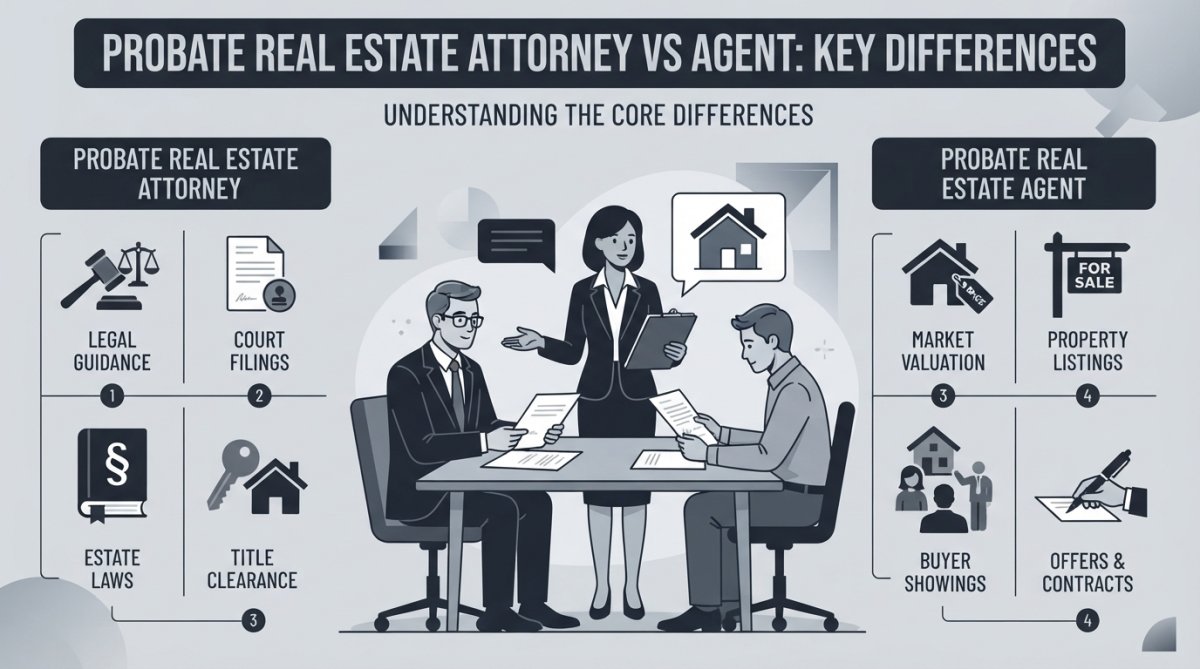
According to The Wagner Law Group’s probate guidance, probate real estate transactions involve specific court approval processes and fiduciary duties that differ fundamentally from standard residential sales.
| Role | Primary Focus | Legal Authority | Best For |
|---|---|---|---|
| Real Estate Agent | Marketing, pricing, closing speed | None (licensed by state real estate board) | Straightforward probate sales with no disputes |
| Real Estate Attorney | Legal compliance, court approval, fiduciary protection | Court officer with legal standing | Complex estates, contested sales, title issues |
| Both Together | Full protection + market expertise | Combined authority | High-value properties, contested wills, uncertain heirs |
Key Roles at a Glance
A real estate agent in probate sales lists the property, attracts buyers, negotiates offers, and closes the deal efficiently. A probate real estate attorney represents the estate’s legal interests, files documents with probate court, ensures compliance with state probate law, and protects against future liability claims.
The real estate agent focuses on "Will this property sell and at what price?" The attorney focuses on "Is this sale legally valid and does it protect the estate from liability?"
Many executors hire an agent first, then discover mid-transaction that probate court requires attorney approval for the sale. Starting with clarity on your state’s requirements saves weeks of delays.
Roles and Responsibilities of a Real Estate Agent in Probate Sales
A probate real estate agent lists the property on the MLS, prices it competitively, markets it to qualified buyers, negotiates purchase agreements, and coordinates closing logistics. They understand executor responsibilities and probate court timelines, including that properties may need to be sold "as-is" and that closing timelines must account for probate deadlines.
However, probate agents have no legal authority over court filings, deed transfers, or title insurance matters. If the sale involves title disputes, unknown heirs, or contested claims, an agent alone cannot resolve these issues.
ProbateData’s probate lead insights shows that agents working probate transactions need specialized training in executor liability and court notification requirements, areas where standard real estate licensing provides minimal guidance.
Roles and Responsibilities of a Real Estate Attorney in Probate Transactions
A probate attorney ensures the sale complies with state probate law and protects the estate from future liability. They file petitions with probate court, serve notice on all heirs and interested parties, respond to court objections, and ensure the sale price is fair and reasonable.
In many states, the probate attorney also handles the closing attorney function, preparing and recording the deed transfer, conducting title search and insurance, and ensuring clear title passes to the buyer. Probate attorneys also manage fiduciary duty obligations, documenting that the sale process was fair, transparent, and properly authorized, protecting the executor from personal liability.
Additionally, attorneys address probate-specific complications: unknown heirs, creditor claims, contested wills, tax liens, or properties with multiple owners. A real estate agent cannot navigate these legal waters.
Selling a probate property without attorney review in states requiring court approval exposes the executor to personal liability. If a beneficiary later claims the sale was improper, the executor may be personally responsible for the difference in value.
Understanding Probate Court Approval and Legal Requirements
Probate court approval requirements vary dramatically by state and property ownership type. In some states (California, Arizona, Florida), probate court must approve the sale before it closes, adding 4-8 weeks to the timeline. In other states, court approval is not required if the executor has clear authority under the will or state law. A few states allow independent administration, where the executor operates with minimal court oversight.
An agent may know these rules generally, but they cannot file court petitions, respond to objections, or represent the estate before the judge. An attorney must handle these functions. Attempting to sell without proper court approval can void the entire transaction.
The CREM Group’s probate process overview emphasizes that Southern California probate sales require formal court approval, making attorney involvement non-negotiable in that market.
Executor Responsibilities in Real Estate Sales
The executor holds fiduciary duty, a legal obligation to act in the beneficiaries’ best interests. They must obtain proper authority to sell, ensure the property is properly marketed, verify the sale price is fair, and disclose any material defects, liens, or title issues to buyers.
Executors must also manage the timeline, as probate estates have deadlines for creditor notification, claim settlement, and estate closure. An executor working with only a real estate agent may inadvertently violate fiduciary duties by accepting an offer below fair market value, failing to disclose known defects, or proceeding without proper court approval. An attorney ensures these duties are met.
The Probate Real Estate Process: When Attorney vs Agent Expertise Matters
The probate real estate process unfolds in distinct phases, each requiring different expertise.
Title Search and Due Diligence Phase
Before marketing a property, the estate must verify clear title and identify any liens, easements, or encumbrances. A title search reveals whether the deceased owner held clear title or whether there are creditor claims, tax liens, or judgment liens against the property.
An attorney orders the title search, reviews it for issues, and determines what must be resolved before sale. They also handle title insurance, a critical protection that guarantees the buyer receives clear title and protects the estate from future claims. A real estate agent can coordinate the title search, but they cannot interpret complex title issues or advise on legal solutions.
Title problems discovered after closing can void the entire transaction. [Probate properties](/burbank-trust-probate-home-sales/) require thorough title review before marketing begins, not after an offer is accepted.
Purchase Agreement and Contract Negotiation
A real estate agent negotiates price, contingencies, and closing timeline. However, probate purchase agreements include probate-specific language: court approval contingencies, representations about the executor’s authority, and provisions for how probate court approval will be handled. An attorney must draft or review these clauses to ensure the estate is protected.
If the property has title issues, liens, or other complications, the purchase agreement must address how these will be resolved and who bears the cost. In complex probate sales, the attorney drafts the agreement and the agent negotiates terms. In simpler sales, the agent may use a standard form that the attorney reviews.
Closing Disclosure and Deed Transfer
At closing, the deed is transferred to the buyer and funds are distributed. The closing disclosure must account for all liens, creditor claims, and costs. An attorney verifies this calculation and ensures the closing statement is accurate.
The deed transfer itself must be properly prepared and recorded with the county. In many states, only an attorney or title company can legally prepare and record the deed. If probate court approval was required, the attorney files a final accounting with the court, documenting how the sale proceeds were used. Skipping attorney review at closing is where many probate sales go wrong.
Probate Attorney Fees vs Agent Commission: Cost Comparison and Transparency
How Attorney Billing Models Work
Probate attorneys use three main billing models: hourly rates, flat fees, or a percentage of estate value. Hourly rates typically range based on local market rates. Flat fees are common for routine probate matters. Percentage-of-estate fees (typically 2-5% of gross estate value) align the attorney’s incentive with the estate’s value.
The key advantage of attorney billing is transparency. Fees are disclosed before work begins, and the executor can budget accordingly.
Understanding Agent Commission Structure
Real estate agents earn commission, typically 5-6% of the sale price, split between the listing agent and the buyer’s agent. The commission incentive is straightforward: the agent earns more if the property sells for more and closes faster, aligning the agent’s interest with maximizing sale price.
However, commission is a percentage of sale price, not a flat fee. For a $500,000 probate property with 5% commission ($25,000), an attorney charging 3% of estate value ($15,000) or a flat fee of $10,000-$12,000 is less expensive.
Request fee quotes from both attorneys and agents before deciding. A probate attorney’s flat fee or percentage may be significantly lower than agent commission, especially for higher-value properties.
When Do You Need a Probate Real Estate Attorney vs Agent?
Scenarios Requiring Legal Counsel
An attorney is non-negotiable if:
- Your state requires probate court approval for the sale
- The title search reveals liens, easements, unknown heirs, or creditor claims
- Beneficiaries dispute the will’s validity or authority to sell
- The property is held in a trust, owned by multiple heirs, or subject to a life estate
- The executor cannot locate all heirs or if heirs are minors or incapacitated
- The estate has significant tax liability, creditor claims, or complex financial issues
Scenarios Where an Agent Suffices
An agent alone may be adequate if:
- Your state doesn’t require court approval and the will grants clear authority
- Clear title exists with no disputes and no liens or complications
- The estate is simple with one property, clear beneficiaries, and no contested claims
- Budget constraints exist, though this carries risk
Even in these scenarios, many executors have an attorney review the purchase agreement and closing documents before signing.
Conflict of Interest Scenarios: When You Need Both
Several scenarios create conflict of interest between agent and attorney interests, making both essential: high-value properties with tight timelines, properties with minor repairs or disclosed defects, multiple offers with varying terms, or beneficiary disagreement about sale strategy.
In these scenarios, the agent and attorney work together, with the executor making final decisions. This costs more than hiring one professional, but it protects the estate and the executor from liability.
Frequently Asked Questions
What is the difference between a probate attorney and a real estate agent?
A probate real estate attorney provides legal counsel on fiduciary duty, contract review, probate court approval, and liability protection. They focus on compliance and legal risk. A real estate agent handles marketing, pricing, buyer negotiations, and market analysis. Agents lack legal authority to advise on probate procedures or represent you in court. Attorneys cannot list properties or act as brokers without separate licensing. Choose an attorney for legal complexity; an agent for transaction execution.
When should you hire a probate real estate attorney instead of just an agent?
Hire a probate attorney when the estate faces contested claims, significant debt, title defects, complex trust provisions, or probate court approval requirements. You need legal counsel if there are disputes among heirs, creditor issues, or contingency clauses requiring legal interpretation. An attorney protects your fiduciary duty and ensures compliance with state bar association requirements. If the probate process is straightforward and all heirs agree, an experienced probate agent may suffice, though many executors benefit from having both professionals.
What are typical probate attorney fees compared to real estate agent commission?
Probate attorney fees vary by billing model: hourly rates typically range $250-$450, flat fees for simple estates range $3,000-$10,000, or percentage-based fees of 2-5% of gross estate value. Real estate agent commissions are typically 5-6% of the sale price, split between listing and buyer's agents. Attorney fees are often paid from estate proceeds, while agent commissions come from sale proceeds. Fee transparency models differ significantly, request detailed fee schedules from both professionals before engagement.
Can a real estate attorney also act as a real estate broker or agent?
A real estate attorney can act as a broker or agent only if they hold a separate real estate broker license from the state bar association. Most attorneys do not maintain both licenses due to conflict-of-interest concerns and liability exposure. Some specialized probate firms employ both licensed attorneys and licensed agents to provide comprehensive services. Before hiring, verify licensing status and ask whether the professional will maintain separate roles to avoid conflicts. This dual expertise can streamline probate transactions but requires clear disclosure.
Do I need both a probate attorney and a real estate agent for a trust sale?
Many trust and probate sales benefit from both professionals working together. An attorney handles legal compliance, deed transfer, closing disclosure review, and fiduciary protection. An agent manages marketing, buyer negotiations, and market positioning. If your estate is complex, has multiple heirs, or involves contingency clauses, legal counsel is essential. A probate-experienced agent can coordinate with your attorney and handle operational details. For straightforward trust sales with clear title and no disputes, an experienced probate agent with attorney consultation may suffice.