
In the California market, your agent isn’t just a facilitator; they are held to the “punctilio of honor the most sensitive,” a legal standard that demands loyalty far exceeding the common morals of the marketplace. This concept of real estate fiduciary duty California agents must uphold serves as your most powerful strategic shield. You might feel a sense of unease regarding high-pressure sales tactics or the weight of managing a complex trust or probate sale. It’s completely understandable to feel anxious about the liability of estate-owned assets or the confusion of ever-evolving disclosure laws.
This guide is designed to provide clarity, precision, and deep legal fluency for your upcoming journey. You’ll learn exactly how to master the legal and ethical obligations your representative owes you to ensure a secure, high-value transition. We will examine the new January 2026 requirements for AI-generated image disclosures, the tobacco residue mandates, and the updated federal reporting for all-cash transactions involving trusts. By the end, you’ll have the confidence to select a partner who offers more than just a listing; they offer a resourceful partnership built on ethics, wisdom, and your choice.
Key Takeaways
- Recognize the legal standard that mandates your agent place your financial interests above their own, ensuring every decision serves your ultimate goal.
- Explore the core pillars of real estate fiduciary duty California professionals must maintain to safeguard your sensitive motivations and price floor.
- Gain the legal fluency required to navigate trust and probate sales, protecting trustees and executors from the risks of personal liability.
- Learn to identify subtle breaches of duty, from self-dealing to undisclosed dual agency, to maintain the integrity of your property’s equity.
- Shift from a transaction-focused mindset to a strategic partnership that values ethics, outcomes, and your autonomy as a seller.
What is Real Estate Fiduciary Duty in California?
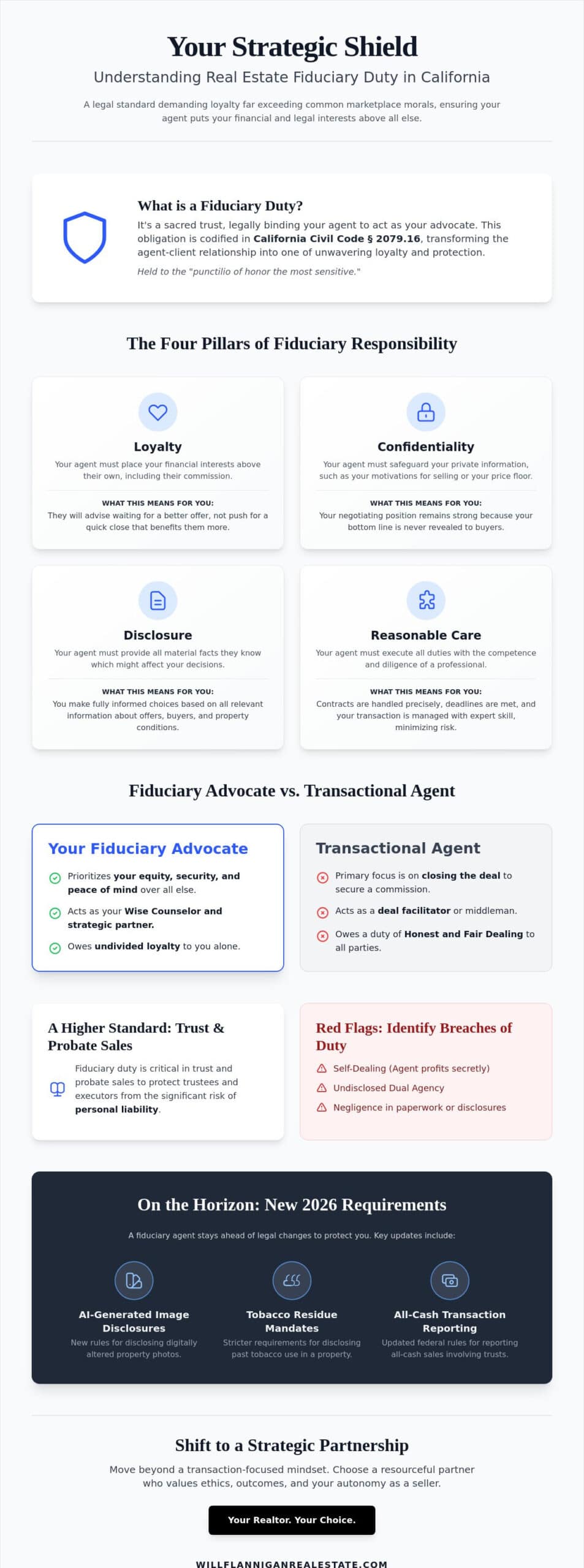
In the complex environment of California property transactions, the relationship between a seller and their representative is governed by the highest standard of care recognized by the legal system. This isn’t a mere business arrangement; it’s a sacred trust. A fiduciary duty requires an agent to place their client’s financial and legal interests above their own at all times. While a transactional agent might focus solely on closing a deal to secure a commission, a true fiduciary prioritizes your equity, your security, and your peace of mind. This obligation is codified in California Civil Code § 2079.16, which serves as the statutory foundation for all agency relationships in the state. Real estate fiduciary duty California law ensures that you aren’t just another number in a high-volume sales machine, but a principal whose goals dictate every strategic move.
The Legal Origin of Fiduciary Obligations
The roots of this duty are deep, mirroring the relationship between a trustee and a beneficiary. When you hire a professional to manage the sale of your home or a trust asset, you’re granting them significant power over your financial legacy. This power is balanced by strict legal requirements. At the very start of your journey, you’ll encounter the Agency Disclosure form. This document isn’t just a formality; it’s a vital protection that outlines the specific responsibilities your agent accepts. These duties are non-negotiable. You can’t waive them in a listing agreement, and an agent can’t opt out of them through fine print. They are inherent to the license and the law, providing a steady foundation of reliability and security.
Fiduciary vs. Arm’s Length Transactions
There’s a sharp distinction between how an agent serves you and how they interact with the rest of the world. In what’s known as an arm’s length transaction, parties typically look out for themselves. However, your agent is your advocate. While they owe a duty of Honest and Fair Dealing to potential buyers and third parties, their primary loyalty belongs to you alone. This distinction becomes critical during high-stakes scenarios, such as navigating multi-offer situations in Pasadena or the Burbank Rancho. Your agent must use their precision, legal fluency, and strategic insight to negotiate the best possible terms for you, even if it means more work or a longer timeline for them. They act as your Wise Counselor, ensuring every disclosure is accurate and every offer is scrutinized for your benefit. Your Realtor. Your Choice. This philosophy is only possible when the fiduciary bond remains unbroken.
The Four Pillars of Fiduciary Responsibility for Sellers
A successful transition in the California market relies on more than just marketing; it requires a structural commitment to your best interests. This commitment is built upon four essential pillars that provide the stability and wisdom needed for a smooth process. When you engage a professional, you’re securing a partner who views your equity as a legacy to be protected. Real estate fiduciary duty California standards ensure that every action taken by your agent serves to maximize your value while minimizing your exposure to risk. These core obligations include:
- Loyalty: Placing your financial goals above the agent’s commission.
- Confidentiality: Safeguarding your private motivations and financial limits.
- Disclosure: Providing all material facts necessary for informed decisions.
- Reasonable Care: Executing every detail with professional competence.
The duty of loyalty is perhaps the most profound. It demands that an agent puts your financial outcome ahead of their own desire for a quick commission. This means advising you to wait for a better offer even when a current one is “good enough” for the agent’s bottom line. Coupled with this is the duty of confidentiality. Your agent is a vault for your sensitive information, including your motivation for selling, your financial status, and your absolute price floor. Finally, the duties of full disclosure and reasonable care ensure that you’re making decisions based on complete information, executed with the precision and diligence of a seasoned expert.
Loyalty and the Conflict of Interest
Dual agency represents a significant challenge to the pillar of loyalty. In California, an agent can represent both the buyer and the seller, but this creates an inherent tension. It’s difficult to provide undivided service when you’re caught between two parties with opposing goals. A true fiduciary will always disclose any personal interest they have in a property or a specific buyer to maintain total transparency. Undivided loyalty manifests when an agent presents an off-market offer alongside a comprehensive market analysis rather than pressuring you toward a convenient, un-vetted sale. If you’re looking for a representative who prioritizes your autonomy, consider exploring our residential property listing services designed with your choice in mind.
The Scope of Full Disclosure
The California Civil Code is explicit about what an agent must share. There’s a vital distinction between material facts about the property and confidential information about the seller. An agent must disclose any fact that could affect the value or desirability of a home in Glendale or Burbank, such as unpermitted additions or local zoning changes. However, they must remain silent regarding your personal reasons for the sale. They must also reveal if they have any existing relationship with the buyer’s side, as this legal fluency prevents hidden biases from tainting your results. This meticulous approach ensures you’re never blindsided by information that should have been shared during the negotiation process.
Fiduciary Duty in Trust and Probate Sales: A Higher Standard
Trust and probate sales demand a level of expertise that goes beyond typical marketing plans. In these transitions, the real estate fiduciary duty California agents owe their clients intersects directly with the complexities of the California Probate Code. This dual layer of responsibility means your representative must act as a protective shield for the estate. When an executor or trustee sells a property, they aren’t just selling a house; they’re fulfilling a legal mandate. Failure to follow the strict protocols of estate sales can lead to personal liability, beneficiary disputes, or significant court delays. A steady, considered advisory style is essential to manage these sensitive matters with the weight they deserve.
Managing the sale of an estate asset requires more than just a listing service. It requires a resourceful partnership that understands the emotional weight of the transition. Because these sales often involve multiple stakeholders, the agent’s role is to provide a smooth process rooted in transparency. This involves a methodical approach to every disclosure, every offer, and every interaction with the court system. By maintaining a high degree of patience and clinical precision, a fiduciary helps the estate navigate the journey from initial valuation to the final distribution of proceeds.
Protecting the Trustee from Beneficiary Claims
A primary concern for any trustee is the risk of claims from disgruntled beneficiaries. To mitigate this risk, a fiduciary agent ensures the property is marketed transparently and sold for fair market value. This methodical approach is especially critical in high-value enclaves like San Marino or Pasadena, where the expectations for asset protection are exceptionally high. By providing exhaustive documentation and a clear paper trail, the agent demonstrates that the estate’s assets were handled with compassion, precision, and deep legal fluency. This transparency provides the security needed to close the chapter on an estate without the fear of future litigation.
The Role of the Professional Standards Advisor
Precision in contract language is a fiduciary requirement, not a mere preference, when dealing with court-confirmed sales or the Independent Administration of Estates Act. A realtor who serves as a Professional Standards Advisor understands the nuance of these legal frameworks. My background as a former attorney informs this “Protective Expert” role; it allows for a smooth process that anticipates potential hurdles before they arise. Whether it’s navigating the specifics of a “Notice of Proposed Action” or coordinating with legal counsel, this resourceful partnership ensures the estate’s interests are always prioritized. For those requiring specialized legal support, our guide on probate real estate agent Los Angeles attorney referrals offers a strategic path forward.
Identifying and Preventing Breaches of Fiduciary Duty
A breach of duty is more than a professional oversight; it is a fundamental breakdown of the protective shield your agent provides. In the competitive landscapes of Burbank and Glendale, the temptation for agents to prioritize speed over substance can lead to significant legal and financial risks for sellers. Real estate fiduciary duty California law is designed to prevent these failures, yet breaches still occur. Understanding the nuances of self-dealing, undisclosed dual agency, and the commingling of funds is the first step in safeguarding your equity and your legacy. These violations represent a departure from the steady, considered guidance you deserve, replacing a resourceful partnership with a clinical conflict of interest.
The duty of accounting is a critical component of this relationship. It requires your agent to maintain meticulous records of all money, property, and documentation involved in your transaction, particularly regarding earnest money deposits and escrow. Closely related is the concept of negligent misrepresentation. Unlike intentional fraud, where an agent knowingly lies, negligent misrepresentation happens when a professional makes a false statement without a reasonable basis for believing it’s true. This failure of care can be just as damaging as a deliberate lie, resulting in a journey that feels unstable and insecure rather than predictable and secure.
Red Flags Every Seller Should Know
Vigilance is your best defense against a representative who values their commission over your outcome. As a Wise Counselor, I encourage sellers to watch for these specific indicators that an agent may be straying from their fiduciary obligations. If your agent pressures you to accept a lower offer specifically from a buyer they also represent, they may be prioritizing a “double-ended” commission over your equity. Another warning sign is a failure to present all offers in a timely manner, which suggests they’re filtering interest to suit their own timeline. Finally, if you discover an agent has shared your “bottom line” price or sensitive financial status with a buyer’s agent without your explicit consent, your confidentiality has been compromised.
What to Do if You Suspect a Breach
If you suspect your trust has been compromised, your first action’s to document every interaction with clinical precision. Begin by communicating your concerns directly to the broker of record for the agency. If the issue remains unresolved, you may need to involve the California Department of Real Estate (DRE), which oversees professional licensing and disciplinary actions. While resolving issues through the brokerage is often the fastest path, serious breaches regarding estate-owned assets may require independent legal counsel to protect the beneficiaries. If you feel your current representation lacks the necessary ethics and outcomes, please consider our residential property listing services to experience a partnership rooted in integrity, precision, and legal fluency.
Why a Fiduciary Approach is Essential for Los Angeles Sellers
In the high-stakes environment of Southern California, a fiduciary approach is the difference between a mere transaction and a successful emotional transition. Choosing a Wise Counselor ensures that your financial and emotional outcomes are protected, as this level of care provides a shield against market volatility. This standard of care, known as real estate fiduciary duty California homeowners deserve, transforms the agent from a salesperson into a protective expert. By prioritizing ethics over volume, this approach creates an atmosphere of calm reliability. It’s about more than just closing a deal; it’s about honoring the legacy of a family home or an estate asset through compassion, precision, and deep legal fluency.
When choosing a Los Angeles real estate agent, selecting a representative with a legal background offers a unique layer of risk mitigation. This background provides a level of legal fluency that translates into sharper contracts, clearer disclosures, and more strategic negotiations. It allows for a resourceful partnership where every potential hurdle is anticipated and every opportunity is maximized. In a market where complexity is the norm, this level of intellectual rigor is essential for a high-value outcome. Trusted Advisor. Experienced Negotiator. Caring Fiduciary. These roles converge to provide a smooth process for every client.
Strategic Advocacy in Burbank, Glendale, and Pasadena
Effective advocacy requires a deep understanding of local neighborhood personality. Whether it’s the equestrian charm of the Burbank Rancho or the historic estates of Pasadena, localized knowledge informs the duty of reasonable care. A steady advisory style is particularly beneficial during complex transitions, such as trust or probate sales, where emotions and legal requirements often collide. By integrating legal fluency into everyday real estate marketing, your property is positioned as a strategic asset rather than a simple listing. This methodical process ensures that your journey is predictable, secure, and ultimately rewarding.
Your Next Steps: A Consultation Rooted in Helpfulness
Your journey toward a secure, high-value transition begins with a conversation. I invite you to a confidential strategy session to discuss your specific property goals and the unique needs of your estate. This session isn’t a sales pitch; it’s a deliberate conversation where every point is given its due weight. Your autonomy remains the priority throughout the process because your agency is the foundation of our partnership. Your Realtor. Your Choice. This slogan serves as a recurring reminder that you are the architect of your own results. To begin this resourceful partnership, please Schedule a consultation with Will Flannigan today.
Secure Your Legacy with Strategic Advocacy
Your real estate journey deserves more than a standard transaction; it requires the protection of a dedicated advocate who understands the weight of your transition. We’ve explored how the “punctilio of honor” serves as your strategic shield and why the pillars of loyalty, confidentiality, and utmost care are non-negotiable. Mastering the nuances of real estate fiduciary duty California law ensures that your equity remains protected, especially during the sensitive complexities of trust and probate sales. This legal framework isn’t just a requirement; it’s the foundation of your security.
Selecting a representative who offers legal fluency and localized expertise provides the clarity you need to move forward with confidence. As a former attorney and Certified Probate and Trust Specialist, I serve the communities of Burbank, Glendale, and Pasadena with compassion, precision, and deep legal fluency. This resourceful partnership prioritizes your ethics and outcomes over mere sales volume, ensuring a smooth process from start to finish.
Partner with a Fiduciary Expert: Contact Will Flannigan Today
You have the power to choose a path rooted in reliability and wisdom. Your legacy is worth the protection of a Wise Counselor who navigates every complex contract with your best interests at heart.
Frequently Asked Questions
Is a real estate agent always a fiduciary in California?
Yes, a real estate agent is a fiduciary whenever an agency relationship is established between the agent and a principal. This relationship typically begins the moment you sign a listing agreement or a buyer representation agreement. The real estate fiduciary duty California law mandates requires the agent to act with the utmost care, integrity, and honesty. It’s a non-negotiable obligation that ensures your interests remain the central focus of every strategic decision.
What is the difference between a fiduciary duty and a “duty of care”?
A fiduciary duty is the overarching legal obligation of loyalty and confidentiality, while a duty of care is a specific component of that responsibility. Think of the duty of care as the requirement for professional competence, precision, and diligence in executing the transaction. While duty of care focuses on the quality of work, the broader fiduciary duty ensures that the work is performed solely for your benefit rather than the agent’s gain.
Can a real estate agent represent both the buyer and seller in California?
Yes, California law allows for “dual agency,” provided both the buyer and seller give their informed, written consent. This situation creates a delicate balance where the agent must remain neutral and cannot disclose confidential price information to either side. Many sellers in competitive markets like Pasadena prefer a dedicated advocate to avoid the inherent conflicts of interest that arise when one person navigates both sides of a high-value transaction.
What happens if a real estate agent breaches their fiduciary duty?
A breach of fiduciary duty can lead to severe consequences, including the loss of the agent’s commission, the rescission of the contract, or a civil lawsuit for damages. The California Department of Real Estate (DRE) may also suspend or revoke the agent’s license following a formal investigation. Because real estate is an emotional transition and a significant financial event, the law provides these strict remedies to protect your equity and your legacy.
Does fiduciary duty apply to trust and probate sales differently?
Fiduciary duty in trust and probate sales is often considered a “higher standard” because the agent owes obligations not just to the trustee, but indirectly to the beneficiaries. The agent must ensure the property is sold for fair market value to protect the estate’s assets from claims of mismanagement. This requires a level of legal fluency and methodical documentation that exceeds the requirements of a standard residential sale in neighborhoods like the Burbank Rancho.
How do I know if my realtor is acting as a fiduciary?
You can verify your agent’s status by reviewing the “Disclosure Regarding Real Estate Agency Relationship” form you signed at the start of your journey. Beyond the paperwork, a true fiduciary acts as a Wise Counselor, providing market analysis that prioritizes your outcome over a quick sale. If your representative is transparent about conflicts and protects your price floor with clinical precision, they’re fulfilling their fiduciary obligations.
Are there specific fiduciary requirements for luxury real estate in Los Angeles?
While the statutory real estate fiduciary duty California law imposes is the same regardless of price, the “reasonable care” expected in luxury transactions is significantly more complex. Managing a high-value estate in Los Angeles involves navigating intricate disclosures, sophisticated marketing, and high-level negotiations. A Protective Expert must apply a greater degree of diligence to handle the unique legal and financial nuances associated with luxury assets and international buyers.
How long does an agent’s fiduciary duty last after the sale closes?
The duty of confidentiality typically survives the close of escrow and lasts indefinitely. While the active duties of loyalty and disclosure generally end when the agency relationship terminates, an agent can’t use the sensitive information they learned during your journey to your disadvantage. This enduring protection ensures that your financial status and motivations remain private long after you’ve moved on to your next chapter.